93 subagents built an OS kernel that runs Doom for under $1,000
Google DeepMind's Kevin Hou argues that as models get smarter, product teams should remove structure rather than add it — even features users love, like chat sidebars. His proof point: a swarm of subagents built a working OS kernel that plays Doom in 12 hours for under $1,000.
- Core principle — Hou frames the talk around 'give Messi the ball and get out of the way': products should scale automatically as the underlying model gets smarter, per Antigravity, Google's agentic coding product launched November 2025.
- Antigravity 2.0 — At Google I/O last month, Antigravity 2.0 decoupled the IDE from the agent manager into two separate applications, adding subagents, new models, worktrees, scheduled tasks and voice mode.
- Tooling timeline — Hou traces coding tools from 2022 autocomplete and chat sidebars (embeddings, rule files, syntax-tree parsing) to 2024 agents (MCPs, custom tools, permission systems) to 2025 agent managers (skills, hooks, artifacts).
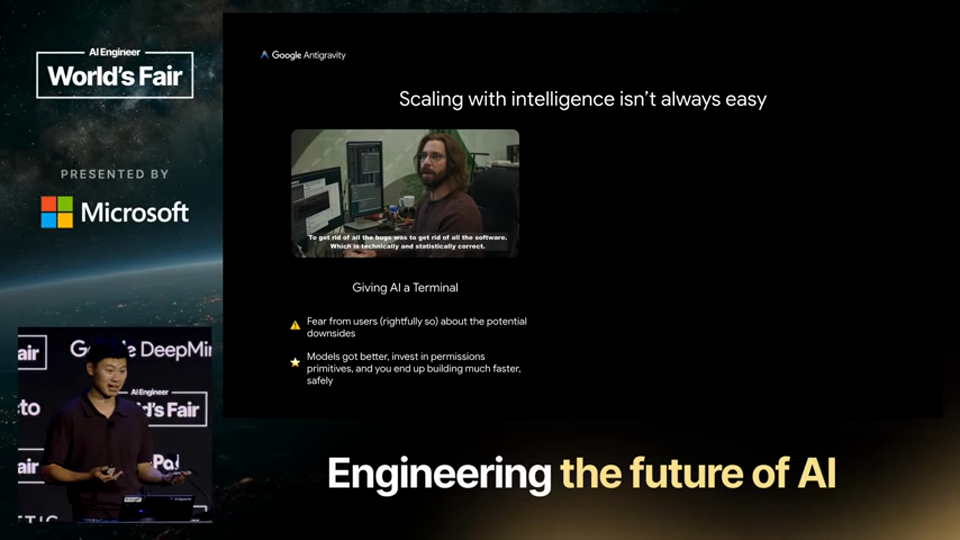
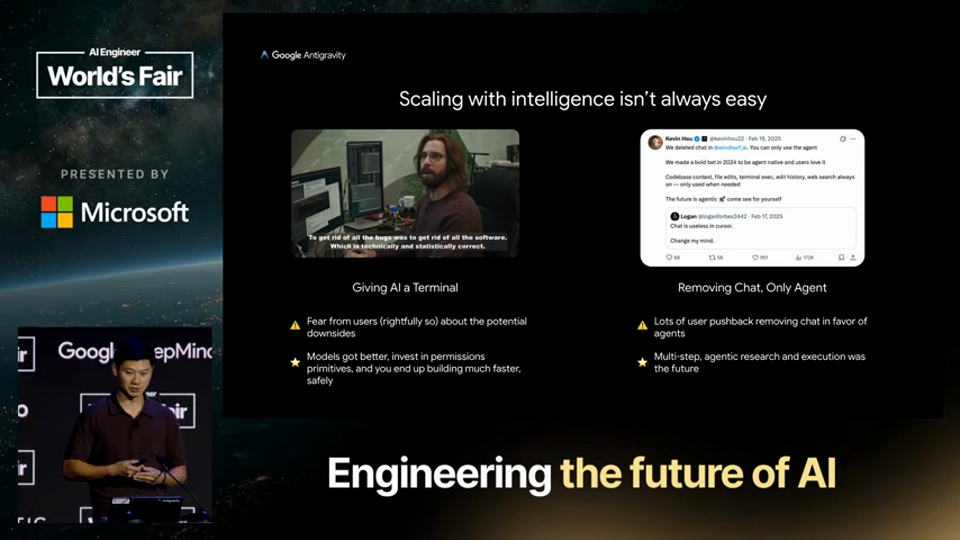
- Terminal fears — He recalls fears of 'son of Anton' deleting entire codebases when AI got terminal access, resolved as permission systems and smarter models let users ship faster and safely.
- Windsurf backlash — Removing the chat sidebar from Windsurf in favor of an agent-only interface drew user backlash on Twitter at the time but proved right as agentic execution became standard.
- /teamwork mode — Gemini 3.5 Flash, launched in April, now leads teams of dynamically generated subagents through a new /teamwork slash command in Antigravity, assigning roles like frontend, backend, infra, QA and design.
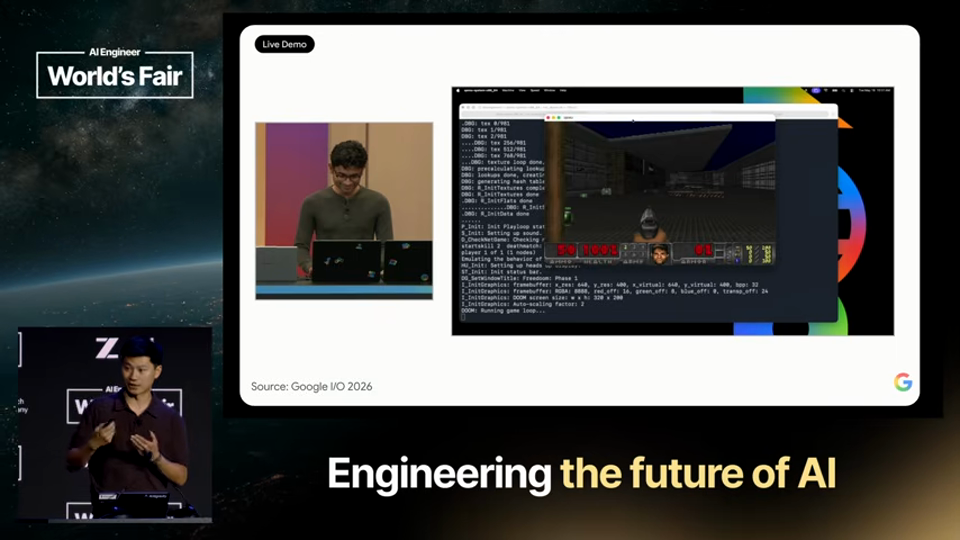
- Doom kernel run — The hero demo shown at Google I/O used 93 subagents over 12 hours, 15,000 requests and 2 billion tokens, costing under $1,000, to build an OS kernel from scratch that runs Doom.
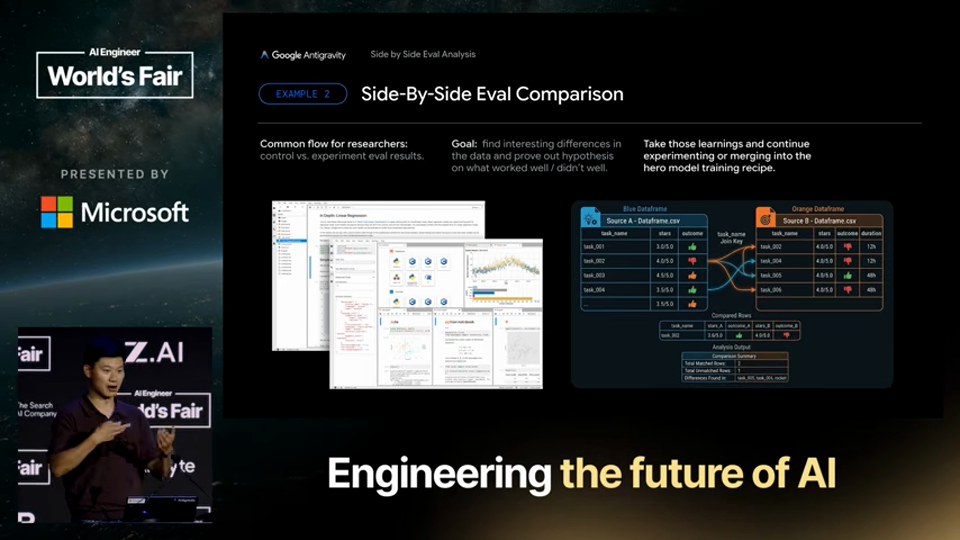
- Eval automation — DeepMind researchers automated 90% of side-by-side eval analysis by having an agent spin up 100 parallel hypothesis subagents to explain performance deltas, replacing manual Jupyter-notebook work.
- Three primitives — Hou names three building blocks of the 2026 'agent teams' era: dynamic subagents, sidecars (a new plugin protocol for webhooks, cron jobs and messages, spec releasing later this summer), and generative UI.
- Generative UI speed — Gemini Flash on Antigravity runs at almost 900 tokens per second, about 10x faster than other frontier model experiences, enabling UI like Kanban boards or timelines generated on the fly.
- Jobs analogy — Hou compares generative UI to Steve Jobs's justification for removing the iPhone's keyboard, arguing fixed mechanical UIs should give way to interfaces that scale dynamically with agent needs.
In their words
So a lot of users were yelling at our team because we took away something that was very dear to them the chat sidebar and replaced it with only an agent.5:12
We believe that the IDE is to the agent manager what the debugger was to the IDE. You don't always need a debugger, but it definitely is helpful to have it if you need to go a layer beneath and go one step deeper into that abstraction stack.5:46
And some of the stats out of this, it took 93 sub aents over the course of 12 hours, made 15,000 requests, two billion tokens, and it was under $1,000, which was one of the really cool aspects of this project.10:33
So researchers were able to automate 90% of this workflow by simply asking the agent about the eval in question using natural language.12:10
Disclosure · Kevin Hou leads engineering on Antigravity at Google DeepMind and is describing his own team's product.
One thing to add — One thing to add — the $1,000/93-subagent kernel demo is presented as a showcase "hero run," not a routine cost, and Hou himself says nobody would spend that daily; the eval-automation figures (90%, 100 hypotheses) come from internal DeepMind tooling that outside developers can't yet inspect.
One thing to try tonight
Try Antigravity's /teamwork command on a real coding task tonight and watch how it dynamically spins up and names specialized subagents (frontend, QA, infra) rather than running one flat agent.