OpenAI's Charlie Guo: voice agents don't have to talk back
A talk that overturns the default assumption behind most voice-agent demos: that the model must answer in speech. Charlie Guo of OpenAI argues speech-to-speech is only one of three decades-old interaction modes, and the most neglected one — speech-to-action, where talking triggers tool calls — is where the real capability overhang sits.
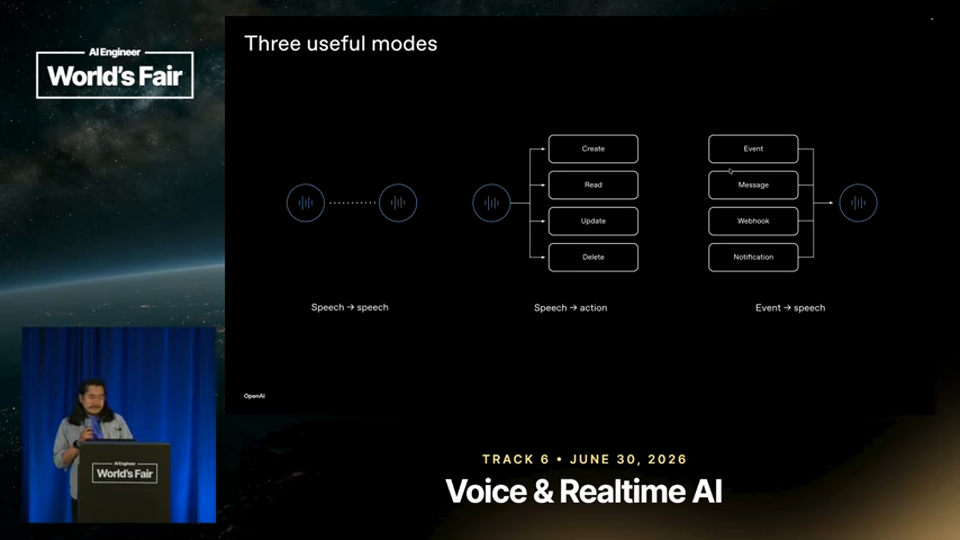
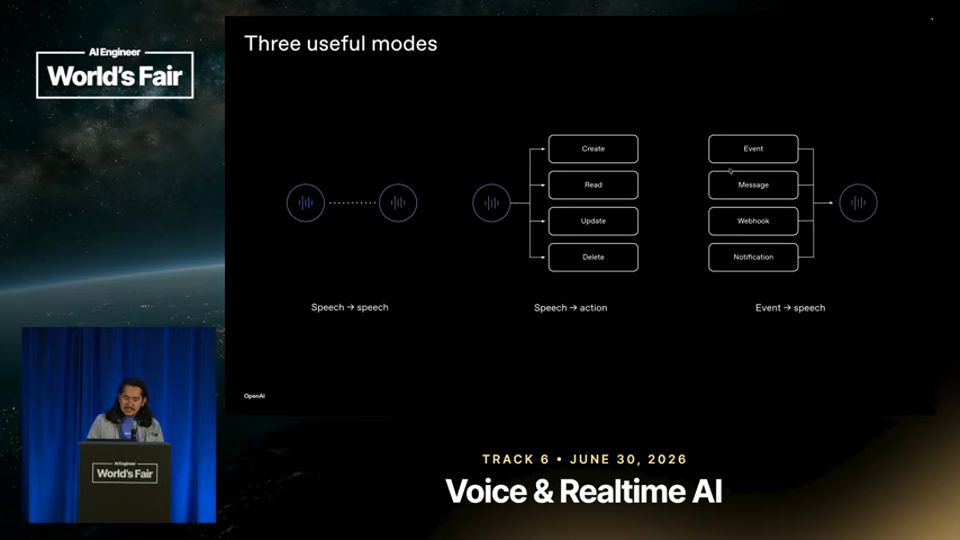
- Three old modes — Guo names three voice interaction modes — speech-to-speech, speech-to-action, and event-to-speech — and says none are new: the Moviefone hotline was speech-to-speech and car GPS navigation has been event-to-speech since he was a kid.
- Speech-to-speech uses — He gives language-learning coaching, 'concierge' customer-support experiences, and real-time live translation (with a guess that next year's keynote could be dubbed live across languages) as speech-to-speech examples.
- Capability overhang — Guo says he almost titled the talk 'Voice is the next capability overhang' because speech-to-action, where talk triggers tool use, is the most underexplored category.
- Form filling — He proposes replacing an hour of typing a government form with five minutes of talking and a 90%-complete draft to check.
- Creative tools — He wants voice integrated into tools like Photoshop and Ableton so people whose taste exceeds their software skill can 'vibe create, vibe compose, vibe paint,' contrasting this with how he can already direct Codex in software's own language.
- Computer use — He frames the generalizable endpoint as computer use: if a model can do everything on a computer a human can, the question becomes why talk to one app or terminal instead of the whole machine.
- Developer on-ramp — Guo says existing API endpoints and React hooks already expose an app's verbs, and each can be converted fairly directly into a tool a voice model calls, letting users drive existing software by voice.
- Non-speech replies — He lists notifications, popups, button color or drop-shadow changes, text highlighting, and the Codex app's ghost-cursor animation as decades-old ways software already replies without words.
- Event-to-speech — He calls this mode still very exploratory, citing hands-free cooking-app scenarios and proactive outreach as an escalation path from animation to pop-up to speech when a user's attention is needed.
- Accessibility — Guo says he knows developers who lost hand mobility or finger dexterity and thought their programming careers were over until coding and voice agents let them generate orders of magnitude more code.
- Chained vs native audio — He contrasts the traditional chained pipeline (transcribe, send text to an LLM, synthesize audio) with OpenAI's real-time model family, which is trained on native audio tokens with no transcription step, citing the claim that 55% of face-to-face communication is body language, 38% tone, and 7% words.
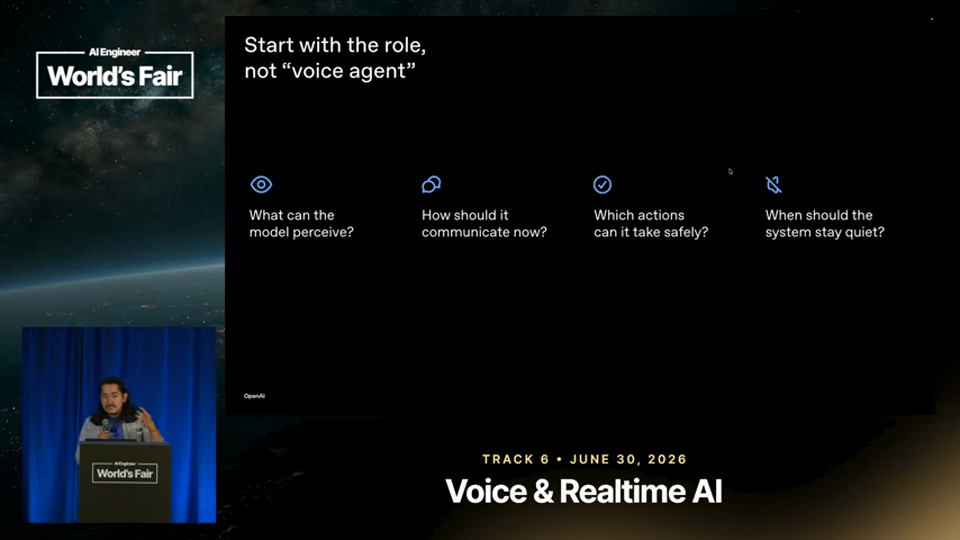
- GPT Realtime 2 — Guo pitches GPT Realtime 2, OpenAI's latest real-time model released a couple of months earlier, which adds reasoning before speaking, parallel tool calls, 'preambles' that let the model narrate delays (e.g., a travel agent saying it's checking flight prices), longer context, and wake-word naming like 'Hey, Marin.'
In their words
speech is not the only way that a voice model has to respond0:48
they're not meant to be mutually exclusive2:11
there's a long history of building these types of systems in and around voice1:26
AGI will be spoken, not typed15:08
Disclosure · Charlie Guo works on developer experience at OpenAI and directly promotes OpenAI's GPT Realtime 2 model during the talk, which he flags himself as a "shameless plug."
One thing to add — One thing to add — the 55/38/7 body-language-tone-words statistic Guo cites is a widely circulated but long-disputed reading of 1960s Mehrabian research on emotional inconsistency, not a general law of communication, so it should be read as illustrative rather than rigorous. His closing line that "AGI will be spoken, not typed" is his own framing and worth treating as a rhetorical flourish rather than a company roadmap claim.</note> </invoke>
One thing to try tonight
Pick one existing API endpoint or button handler in your app tonight and wire it as a callable tool for a real-time voice model, then test triggering it by voice instead of a click.