Oracle PM: four database types can't agree on a fact whispered once
Kay Malcolm found that AI made every engineer on her split US/Europe team faster but never made the team more productive, because Git captured code changes but not the reasoning behind them. Her answer isn't a new agent framework — it's arguing that memory belongs in a single database, not scattered across specialized stores that can't talk to each other.
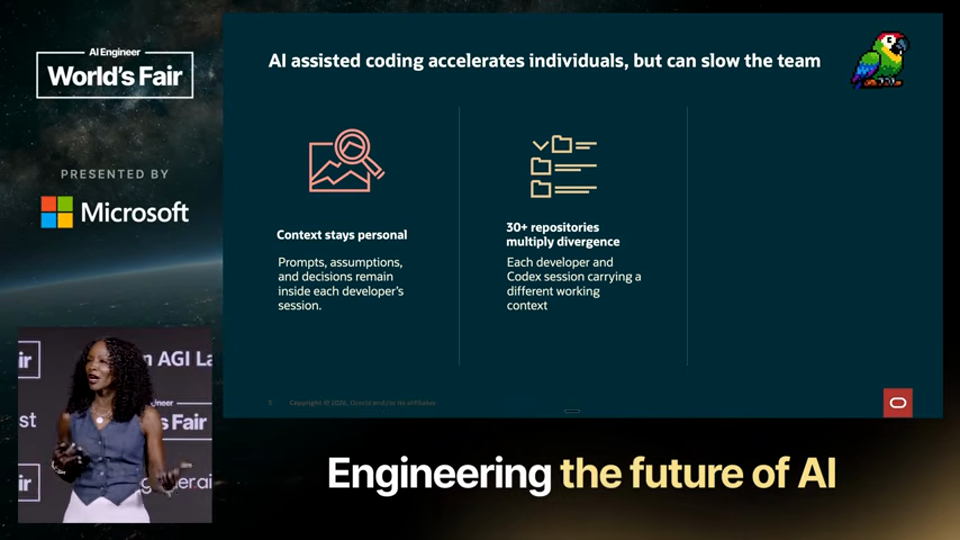
- The problem — When Malcolm's Netherlands-based teammates checked in code at 4am her time via Codex, the US team got the code but none of the context, because Git records what changed, not why.
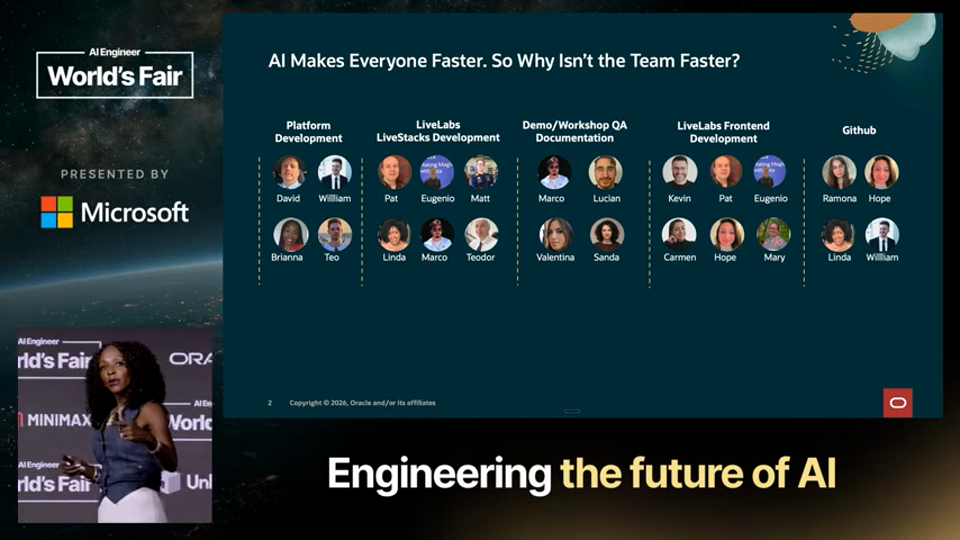
- Her team — Malcolm runs an outbound database product management team at Oracle, where she has worked 20 years, spanning platform development, Live Labs content, QA, and front-end AI development.
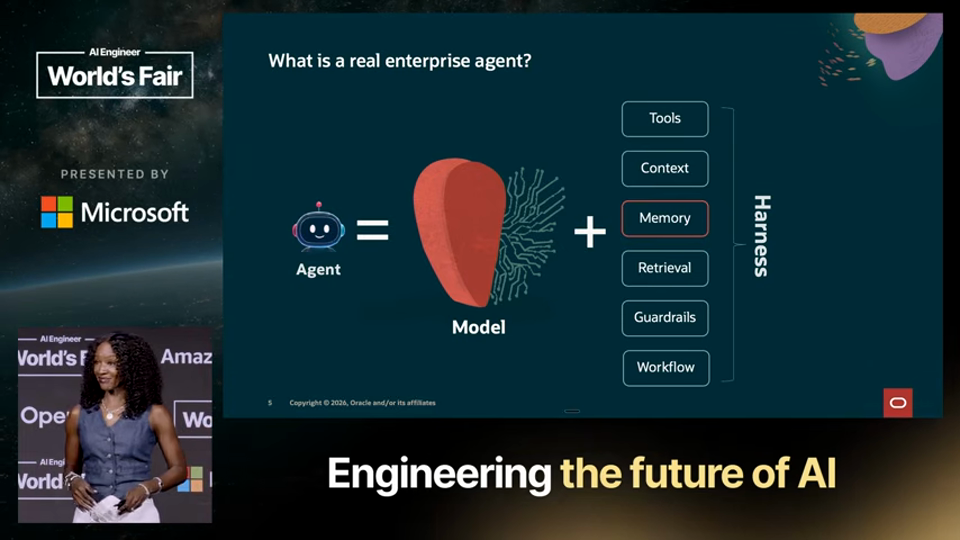
- Enterprise agent defined — Malcolm argues a real enterprise agent is model plus tools, context, memory, retrieval, and guardrails (the harness) — not just model and workflow.
- Anatomy analogy — She frames the model as a brain in a jar, the harness as the body, and memory as the central nervous system carrying context between them.
- Five memory types — She names short-term (session), long-term (cross-session), episodic (what happened last time), procedural (steps taken), and semantic (meaning) memory.
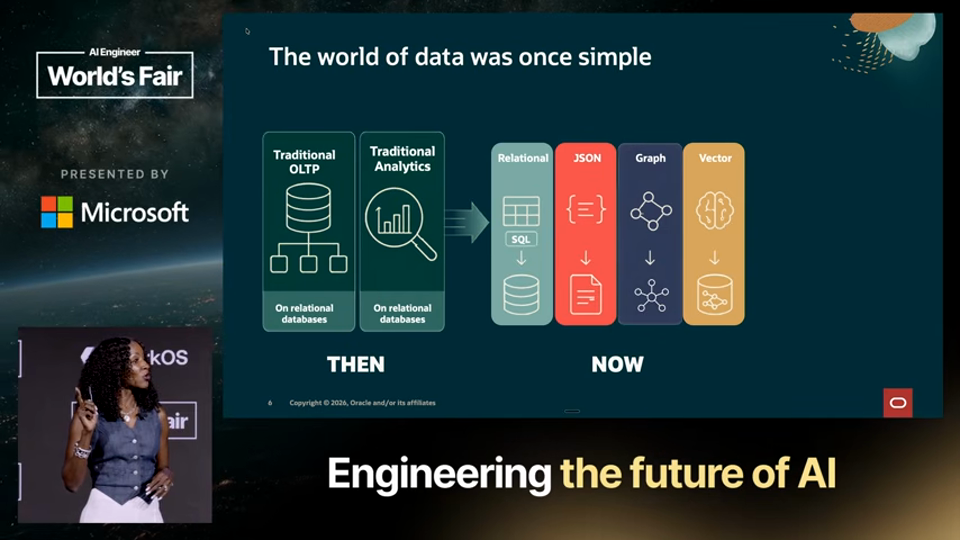
- Southern Company story — As a DBA at Southern Company, Malcolm attended two standing meetings per database system for security and patching; adding a document store made it four, adding Neo4j for a graph relationship query made it six, and she quit.
- Fragmentation demo — She staged four audience volunteers as relational, document, graph, and vector stores, told them a single sentence to remember, and had them whisper answers — they couldn't agree on who held the truth.
- Oracle's pitch — Oracle's 26AI database can natively store JSON, graph, vector, spatial, and immutable blockchain data in the same table down to the same partition, across AWS, GCP, Azure, OCI, or on-prem.
- Py the memory broker — Malcolm's team built a memory broker named Py using Oracle Agent Memory to share procedural, episodic, and long-term memory context across forks, branches, and commits so developers stayed in control.
- Outside validation — She cites an OpenAI paper saying its in-house data agent needed memory to filter correctly instead of string-matching, and quotes Harrison Chase: "Your harness, your memory... if you don't own your harness, you don't own your memory."
- The SDK — Oracle offers a pip-installable Oracle Agent Memory package that stores live conversations and facts in an Oracle Autonomous Database, usable with any LLM or a local model via Oracle's private AI services container.
- Freebies — Malcolm pointed attendees to the Oracle AI Developer Hub, Livelabs.oracle.com (which she wrote six years ago, now with 40 million users), and Oracle's always-free OCI tier offering a free database, compute, 3,000 emails a month, and 200GB storage.
In their words
while AI was making the individuals on my team faster, there was another problem it was creating. It wasn't making my team more productive.1:52
git records the code and not human intent3:30
So you remember my problem with Git. What I needed was memory.7:01
So if data is in an Oracle database, if then it's also in an unstructured JSON database, if it's in a graph database and it's in a vector database, where is your single source of the truth? The agent has to figure that out. Sometimes it'll get it right. Most times it'll get it wrong12:31
Disclosure · Kay Malcolm works in database product management at Oracle and is promoting Oracle's 26AI database, its Agent Memory SDK, Live Labs, and its always-free OCI tier.
One thing to add — One thing to add — the talk's strongest evidence (the meeting-count story, the whispering-volunteers demo) is anecdotal and staged for effect, and the SDK pitch is Oracle-specific, so the "database is the last line of defense" framing works better as a rhetorical device than as a benchmarked comparison against dedicated vector, graph, or document stores. The OpenAI paper and Harrison Chase quote are cited secondhand from slides Malcolm read on a plane, not independently verified here.
One thing to try tonight
Run "pip install oracle-agent-memory" and read the package docs to see how the Oracle Agent Memory SDK stores conversations, facts, and memory types in an Oracle Autonomous Database, then sketch how you'd wire it into your own multi-agent or multi-timezone coding setup.