Cursor cut 12,000 lines of code to 200 with agent skill files
Philipp Schmid builds the same GitHub PR review agent three times on stage, deleting code with each version until only a markdown file and a bash script remain. The talk argues that as models improve, hand-written tool schemas and orchestration loops become the thing to delete, not the thing to build.
- Interactions API — Schmid introduces Google's new Gemini Interactions API, a unified interface for calling models and agents that replaces turn-based conversation history with a "steps" timeline of user input, reasoning, function call, and function result.
- Version 1: raw Python — The first version is a hand-written Python loop with JSON schema tool definitions and manual function-call parsing; asked "what is the weather in San Francisco," it says it cannot do that because no weather tool was defined.
- Version 2: ADK framework — The second version uses Google's ADK agent framework, which generates JSON schemas from Python function signatures and removes boilerplate, but still fails the same weather question because tools are still explicitly enumerated.
- What frameworks still owe — Frameworks handle turn-taking, routing, and schema generation, but developers still write the Python tool implementations, rules, and hosting environment themselves.
- Anti-gravity remote agent — Announced at Google I/O, the Anti-Gravity remote agent runs on the same harness as the Anti-Gravity IDE's coding agent but is a general-purpose agent with an added "environment" parameter giving access to a hosted, isolated cloud sandbox that runs bash commands and saves files.
- Credential proxy — A network proxy around the sandbox injects credentials on outbound requests so the agent never sees the actual token, and developers can restrict or leave open the list of domains the agent can reach.
- Version 3: files only — The third version has no source directory at all — just an AGENTS.md with system instructions telling the agent it has a GitHub CLI, bash, and a filesystem, plus a bash script that installs the GitHub CLI on first run.
- Weather test passes — Asked the same weather question, version three uses Google Search and answers "around 20°C," because nobody restricted its tools to a fixed list.
- Server-side everything — Loops, tool routing, session/conversation state, and context-window compaction are now managed server-side; developers keep only instructions, skill files, and evals.
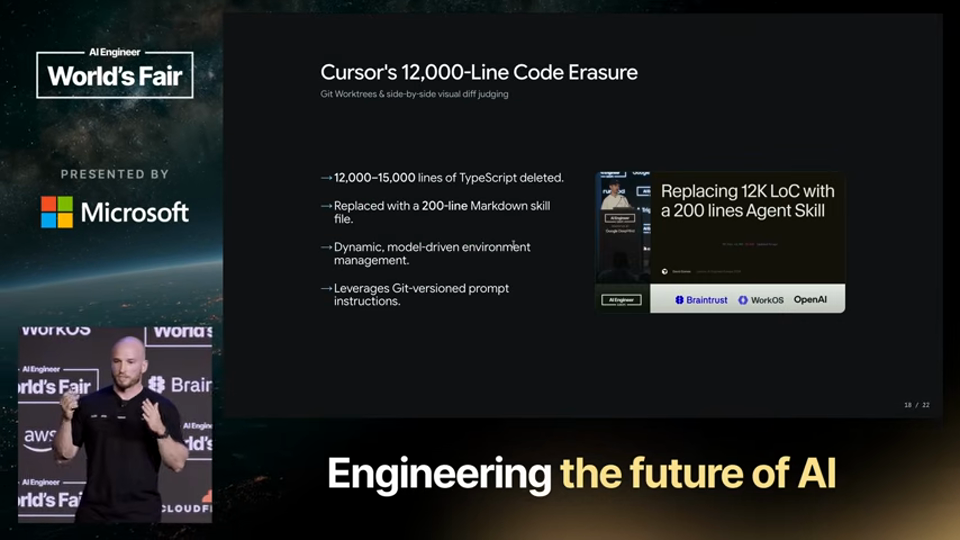
- Cursor's 12,000 lines — Schmid cites a Cursor talk at AI Engineer Europe describing the replacement of roughly 12,000 lines of TypeScript orchestration for git worktrees with about 200 lines of agent skill markdown files.
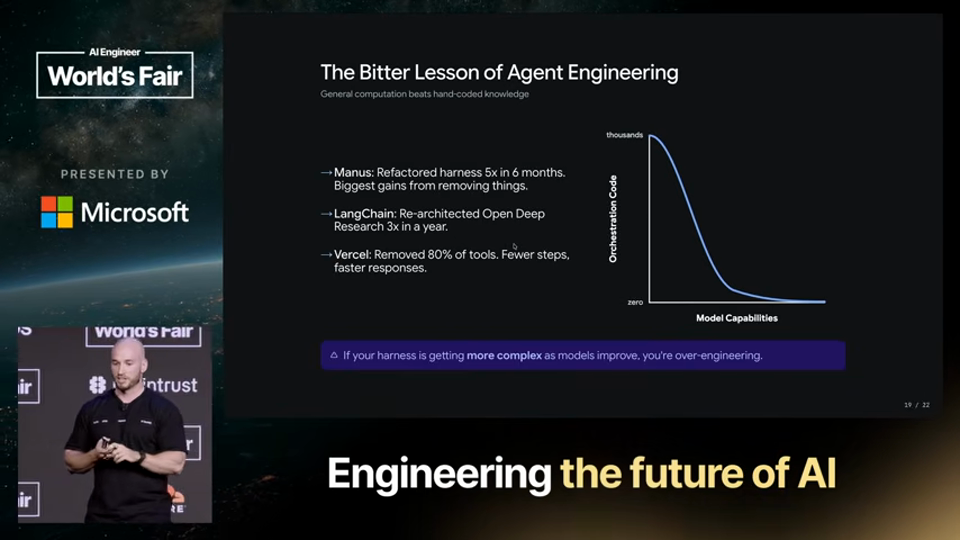
- Other examples cited — He also cites Manus refactoring its harness five times in six months, LangChain rearchitecting Open Deep Research three times in a year, and a tool referred to as "Worsel" in the transcript removing 80% of its tools to get fewer steps, faster responses, and better accuracy.
- Overengineering heuristic — Schmid's closing test: if your agent harness gets more complex as the underlying model improves, you are most likely overengineering it.
- Call to action — He points attendees to a QR code linking to AI Studio to try the Anti-Gravity harness immediately, noting a free API tier is in progress.
In their words
if we ask the agent to do something which it does not have the capabilities to it just says hey I cannot do this4:14
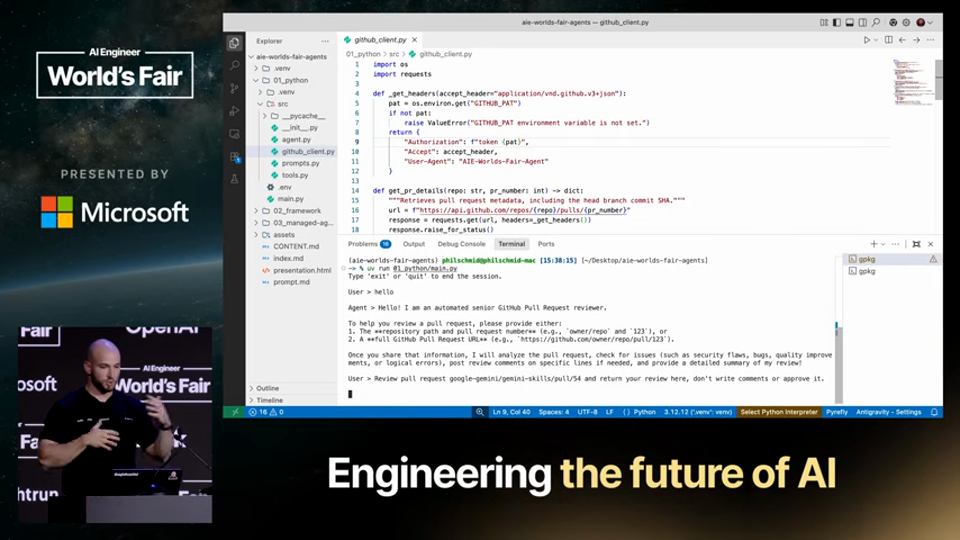
we should get back hopefully a result like hey I cannot do this I don't have access to the weather API which obviously makes sense because we did not define any tool6:27
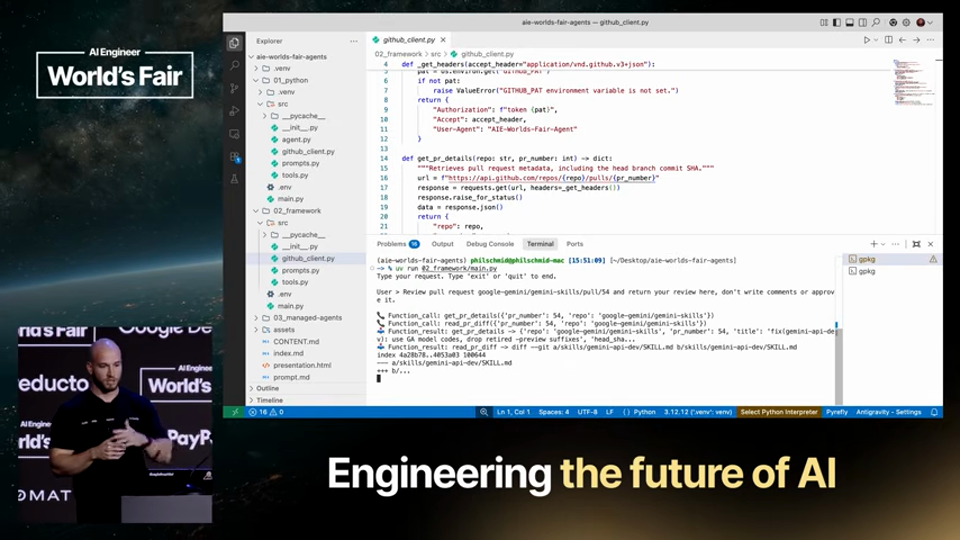
So they had a very hard-coded code um orchestration for doing git work trees and they were m able to replace it with just a skill and markdown files15:21
if your harness is getting more complex as the model improves, you are most likely overengineering your harness15:56
Disclosure · Philipp Schmid works at Google DeepMind and is presenting Google's own Gemini Interactions API and Anti-Gravity agent product throughout the talk.
One thing to add — One thing to add — the "Worsel" reference in the auto-captions is likely a mangled proper noun that could not be confidently resolved, so it is left as transcribed with a caveat. The demo's repeated weather question is a deliberately trivial probe, but it usefully exposes the real distinction: fixed tool lists versus a model trusted to reach for general-purpose tools like search.
One thing to try tonight
Write a one-page AGENTS.md for one of your own scripts that currently hard-codes tool schemas, replacing the schema definitions with plain-language instructions about what CLI tools and filesystem access are available, and see if a sandboxed agent run performs the task without the Python wrapper.