One designer, 140+ sponsors, zero missed logos with AI checks
Vincent Wendy is the only designer at AI Engineer, a 12-to-15-person company whose conference scaled to 7,000 attendees, 140-plus sponsors, 300-plus speakers and 600-plus sessions. He argues that once a design system is locked down tightly enough, an agent like Devin can generate, validate and fix pixel-perfect deliverables faster than a human designer-engineer feedback loop ever could.
- Team size — Wendy says AI Engineer has around 12 to 15 people total, and he is the sole designer.
- Scale numbers — The conference grew from an expected 6,000 to 7,000 attendees, with 140-plus sponsors, 300-plus speakers, and 600-plus sessions.
- Design team — He jokes his design team is himself plus Devin, GPT, and Figma.
- Pelican test — Referencing Simon Wilson's 2025 pelican-riding-a-bicycle test, Wendy says LLMs still can't produce a usable vector file, so he has ChatGPT generate a PNG instead and vectorizes it himself in Figma.
- Five-part method — His approach is foundation first, reusable designs, automated workflows, validated output, and removing friction.
- Locked foundation — He defines desktop and mobile typography, colors, and components explicitly because an LLM will otherwise throw some random font size.
- Reuse across teams — Once the website design system is set, AI Engineer's marketing team builds emails and flyers directly from it without his involvement.
- Room schedules — Room schedules, once built manually in Figma, are now pulled from live data via Devin, exported as PNG, and carried to lobby screens on a flash drive.
- Speaker generator — A generator produces pixel-perfect speaker announcement graphics and trading cards for all 300-plus speakers, styled like TBPN, pulling headshots automatically.
- Photo matching — Devin, running in Slack, matched a photographer's photo to speaker Jason Liu to auto-populate a thumbnail, a task that used to require manually searching through photo codes.
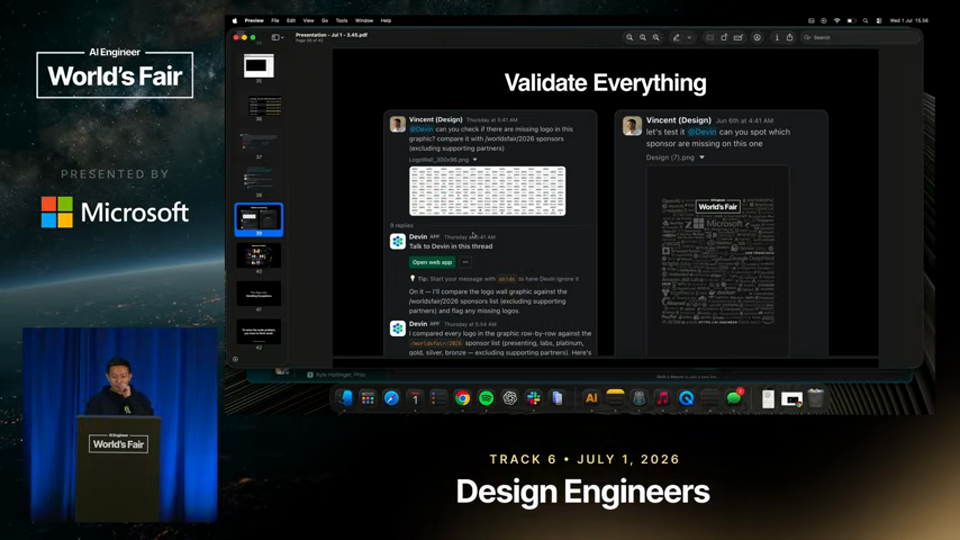
- Sponsor wall check — Wendy asked Devin to check the 140-plus-logo sponsor banner for missing logos and reports 100% accuracy across his tests, repeating the trick on the conference T-shirt.
- Edit button fix — When a schedule needed a last-minute update but the tool had no edit button, Wendy asked Devin to add one that same morning.
- Closing claim — Wendy's takeaway is that tools are no longer the constraint, so having a real problem worth solving is now the designer's advantage.
In their words
And then we have 140 sponsors. More. 140 plus sponsors. And then 300 plus speakers, 600 plus sessions, and one designer.1:47
So, right now we just pull the latest data. I just asked Devin like, "Hey, I want this room at these days." And then we can just export it, download it PNG, and the data is all accurate, and then we can just ship it to the flash drive, and then put it on the screen.7:50
It was like impossible before because the friction is just too much between the designers and the developers.8:12
And I basically tell Devin like "Hi, could you compare could you check if there are any missing logos in this graphic?" And the accuracy is 100% based on the test that I do.13:10
Disclosure · Wendy is describing tools and workflows built for his own employer, AI Engineer, and demoing its conference products.
One thing to add — One thing to add: Wendy's 100 percent accuracy claim on the sponsor logo check rests on his own informal tests, not an independent audit, so it should be read as a personal anecdote rather than a benchmark. His talk is also a case study in one very specific, tightly scoped use of agents, design QA and asset generation within a locked design system, not a general claim about AI replacing designers.
One thing to try tonight
Take one existing design file with a defined type and color system, feed an agent a spec sheet of your spacing and font rules, and ask it to check a real asset, like a logo wall or list, against a source list for missing items.