Why a design AI skill refuses to add an "auto" mode
Paul Bakaus argues design cannot be oneshotted, not now and maybe not ever, because good design is context-rich, iterative, and full of people with opinions. His tool Impeccable doesn't automate design decisions — it gives you loaded vocabulary like "bolder" or "harden" so your coding agent knows what those words mean for your specific project.
- The demo — Bakaus runs the same prompt, "make the workflow section bolder," on a bland site with and without Impeccable installed, then compares it to GPT-5.5 on extra-high without the skill.
- What Impeccable is — It's a design skill that works across Claude Code, GitHub Copilot, Cursor, and Codex, turning a coding harness into a better designer rather than replacing one.
- Roles blurring — Bakaus says engineers and designers are converging into design engineers, and the traditional waterfall handoff from PM to design to engineering is collapsing.
- Two extremes — Designers today either do direct pixel manipulation in Figma/Webflow or go fully agentic with loops, and Bakaus says both miss a middle ground of precise human-in-the-loop control.
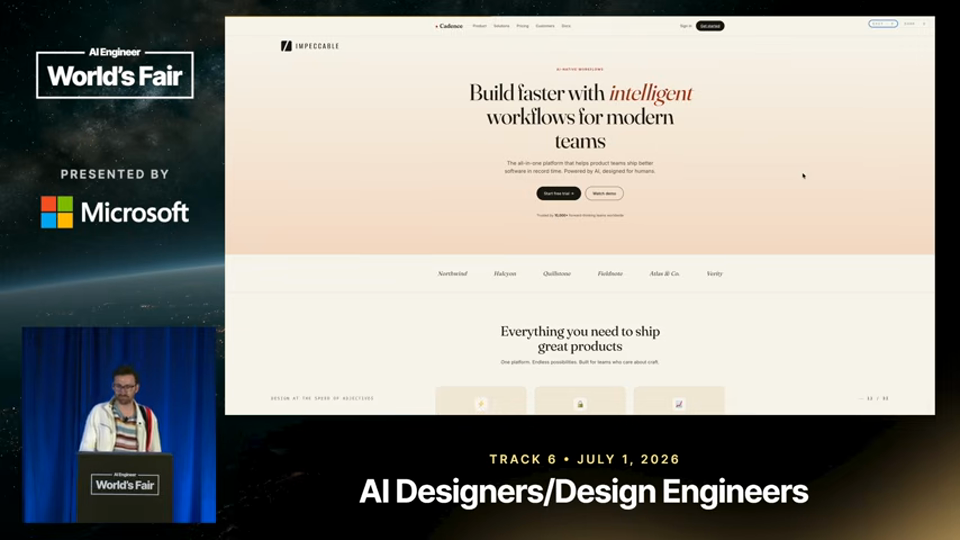
- Claude beige — Purple gradients are gone from frontier models; what replaced them is a beige palette, Instrument Serif fonts, and italics, which Bakaus calls "Claude beige" — not bad design, just identical design.
- Hot take — Bakaus's core claim: you cannot oneshot design, maybe not ever, because it requires context, iteration, and human opinions about emotional territory and audience.
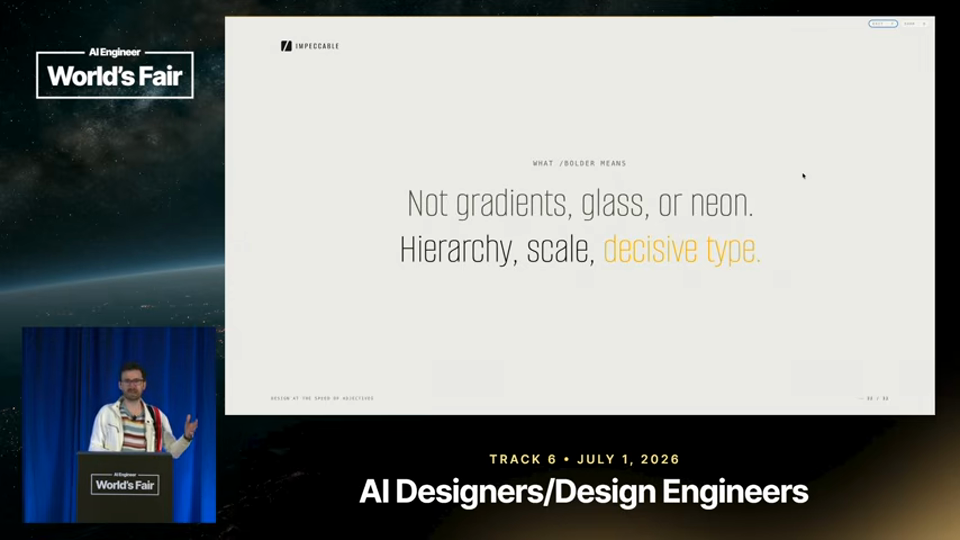
- Loaded adjectives — Words like bolder, quieter, distill, polish, denser, and harden are each infused with project-specific meaning, so "bolder" resolves to hierarchy, scale, and decisive type rather than gradients, glass, or neon.
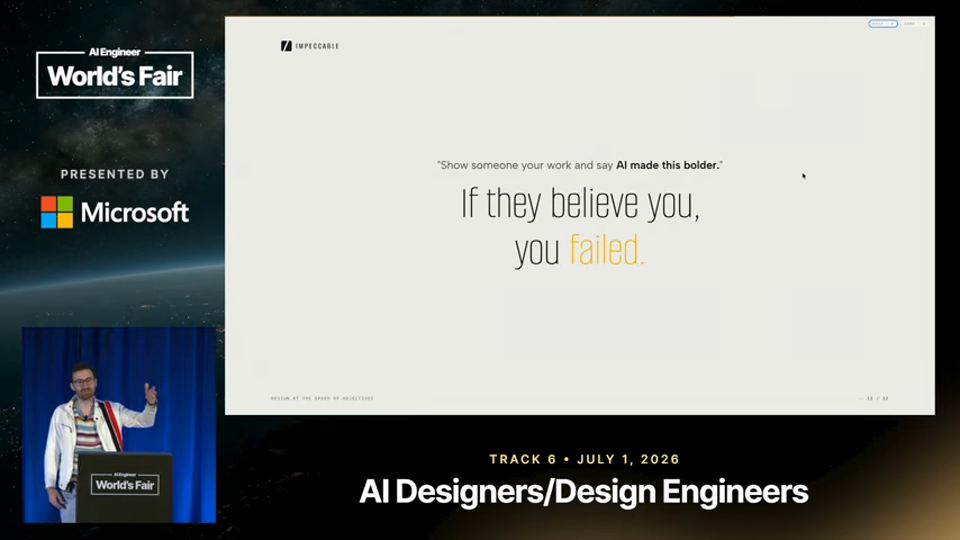
- The instruction — The file loaded for "bolder" tells the agent: show someone your work, say AI made this bolder, and if they believe you, you failed.
- Matt Puk reference — Bakaus credits Matt Puk's idea that an adjective is a "lightwort" (German-derived term) that must be infused with meaning rather than used as a plain prompt.
- Workflow mapping — Bakaus maps design as messy stages — initialization, shaping, crafting, iterating, hardening/polish, and design-debt cleanup — and places Impeccable's commands as injection points along that route.
- Overdrive command — One command, "overdrive," was built half as a joke to push designs over the top, tested on an event-horizon shader from his Radiant Shaders library, and the community loved it.
- No auto mode — Bakaus says he gets weekly requests for an automatic version of Impeccable and is closing an open pull request for it, insisting there is no auto and never will be.
- On taste — Bakaus calls his goal "amplified craft": taste can be sharpened by tools but not lab-grown, since taste is contextual, cultural, and built from scars.
In their words
You cannot oneshot design.5:45
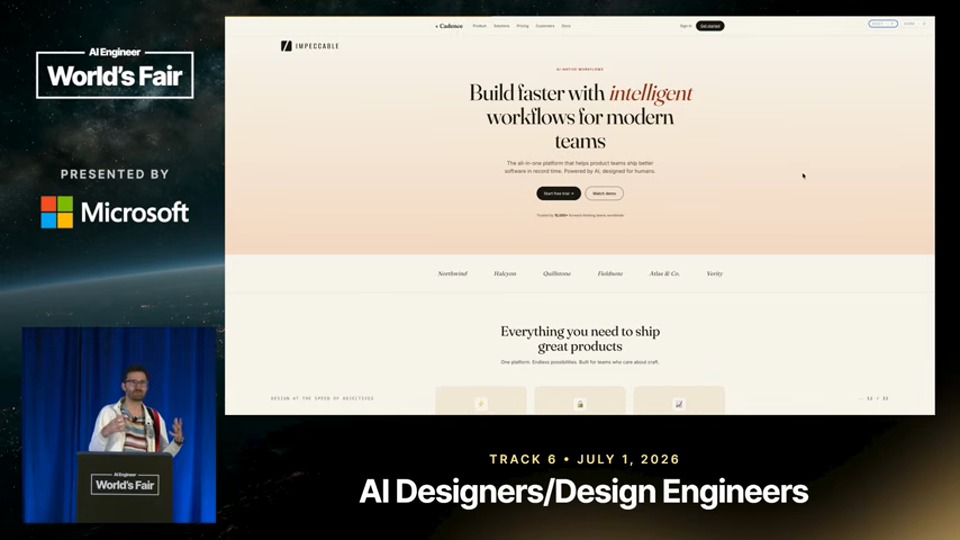
I think in order to build something that really looks and feels great and is effective design, you need to have something that's context context rich which has been informed by what you're trying to do, what your audience is, what you're trying to build.5:57
show someone your work and say AI make this bolder made this bolder if they believe you you failed10:18
an adjective is a light wart and a light wart such a German term10:40
Disclosure · Bakaus is the creator of Impeccable and is presenting/promoting his own tool throughout the talk.
One thing to add — One thing to add — the "Claude beige" observation is a useful reminder that AI aesthetic tells aren't fixed; they're a moving target that shifts with each model generation, so any list of "AI slop" signals has a short shelf life. Bakaus's refusal to ship an auto mode is also a bet against a large chunk of his own user requests, which is a notable stance for a tool built on community feedback.</note> </invoke>
One thing to try tonight
Try running the same UI-tweak prompt twice on a real project: once as plain "make it bolder," and once after writing one sentence defining what bolder should mean for your product (stronger hierarchy and type scale, not new colors), then compare the two outputs.