Design-to-code roundtrip fails: pure AI output starts at 30% fidelity
Jonathan Gordon spent months testing whether AI could finally close the decades-old gap between design and engineering handoffs. It couldn't — five different tool setups all lost bindings or fidelity somewhere in the loop, pushing him to build guardrails instead of trusting the roundtrip claims coming from Anthropic and Figma.
- Origin story — Gordon caught his AI agent writing an innerHTML statement mid vibe-coding session, recognized it as a known injection risk, and told it to revert — the moment he started reading generated code again.
- Background — Gordon has spent more than 30 years building developer tools and IDEs, including accessibility work at Microsoft, and says design-to-engineering handoff was never a solved problem even before AI.
- Defining the goal — He defines a true design-code roundtrip as a full bidirectional loop with zero loss of fidelity and persistent provenance, so any UI element traces back to the exact line of code that produced it.
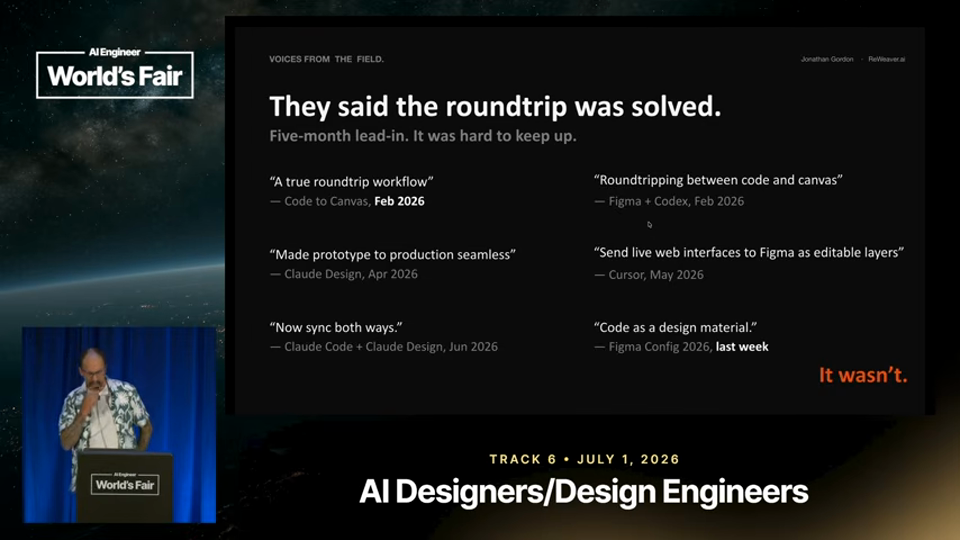
- Industry claims — He references Anthropic and Figma's February demo of Claude Code generating a Figma artboard, and Figma Config's announcement last week that 'code is now material,' both framed as roundtrip solved.
- Testing it — Gordon tried five different tool setups for bidirectional roundtripping and found all of them lossy — bindings dropped, or a design change persisted while the corresponding code did not.
- Building ReWeaver — He built ReWeaver AI and demoed it publicly for the first time: generated code on one side, a Figma canvas on the other, and a 'show drift' button that scans both.
- Drift dimensions — ReWeaver reports drift across dimensions including design quality, code quality, performance, design tokens, and accessibility.
- Accessibility gap — He found models generating components with no ARIA live region, meaning screen readers announce nothing to blind users — a gap he says echoes needing to train engineers on accessibility 20 years ago.
- Fidelity decay test — Running 12 iterations on one codebase, pure LLM output started around 30% fidelity and degraded further, while adding deterministic guardrails held quality higher, though never 100% since the remaining share is human judgment.
- Where things stand — Gordon says today's tools are 'locked into AI' for design-to-code and code-to-design work, span-the-chain workflows across tools, with agents in control and humans merely in the loop.
- Three blind spots — He names three blind spots: the model itself is nondeterministic, drift surfaces in the moment, and drift accumulating over months becomes 'the new tech debt.'
- ReWeaver's design — ReWeaver uses deterministic guardrails across nine dimensions — including design consistency, accessibility, and AI code generation governance — runs on a fully local LLM with zero extra token cost, and never writes code itself, only proposing fixes the human accepts or refuses.
- Try it / beta — Readers can test their own AI-generated code at reweaver.ai/playground, with a challenge to score below 30 PDR (production drift ratio) for a front-line beta seat, ahead of a planned mid-July beta launch.
In their words
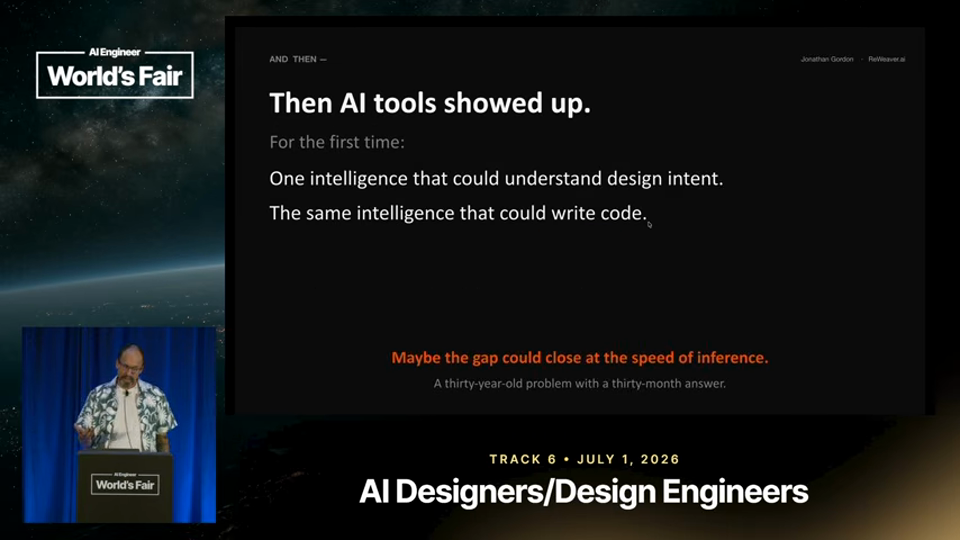
i thought to myself, oh my god, i think we might be able to close this loop.3:17
but they said the roundtrip was solved and I started messing around and realized it wasn't.6:53
there was this demo that showed going from cloud code into Figma. And it was magic. It was incredible.6:14

I really tried hopefully this slide tells you I tried five different tool setups trying to do code design code roundtrip both directions birectional lots of lossy issues uh you know bindings were lost um design change survived but code didn't11:13
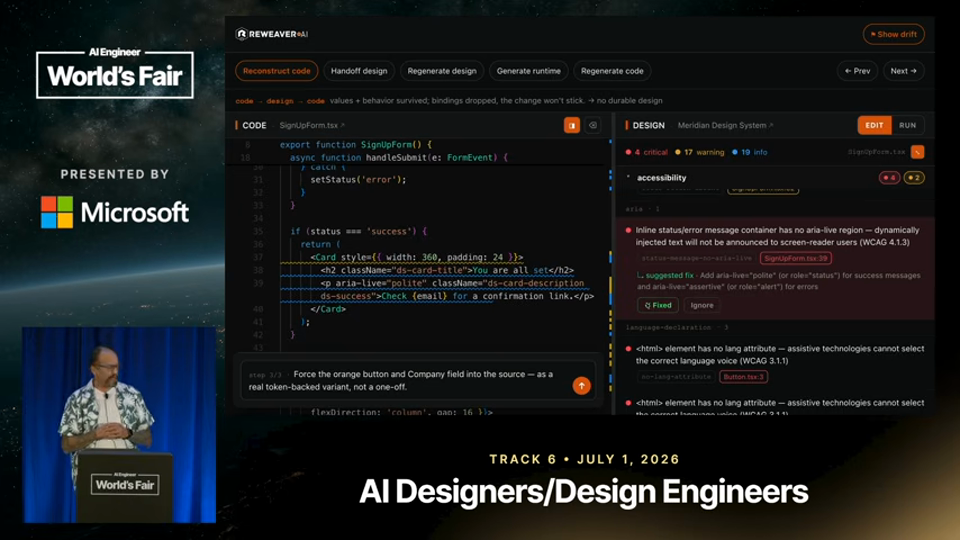
it started at 30% quality, 30% fidelity, 30%, you know, true pixel perfection.12:55
Disclosure · Jonathan Gordon is the founder of ReWeaver AI and used this talk to publicly demo the product and recruit beta users.
One thing to add — One thing to add — Gordon's own numbers (30% fidelity, 12 iterations, nine dimensions) all come from internal, unpublished tests on his own tool, so they should be read as a vendor's demo claim rather than independently verified benchmarks. The talk is most useful not for ReWeaver itself but for its documentation of how the Anthropic/Figma "roundtrip solved" narrative breaks down under actual use.</note> </invoke>
One thing to try tonight
Take a recent AI-generated UI component from your own codebase and grep it for innerHTML and missing ARIA attributes before merging, the same manual check that started Gordon's whole investigation.